On this page · 12 sections
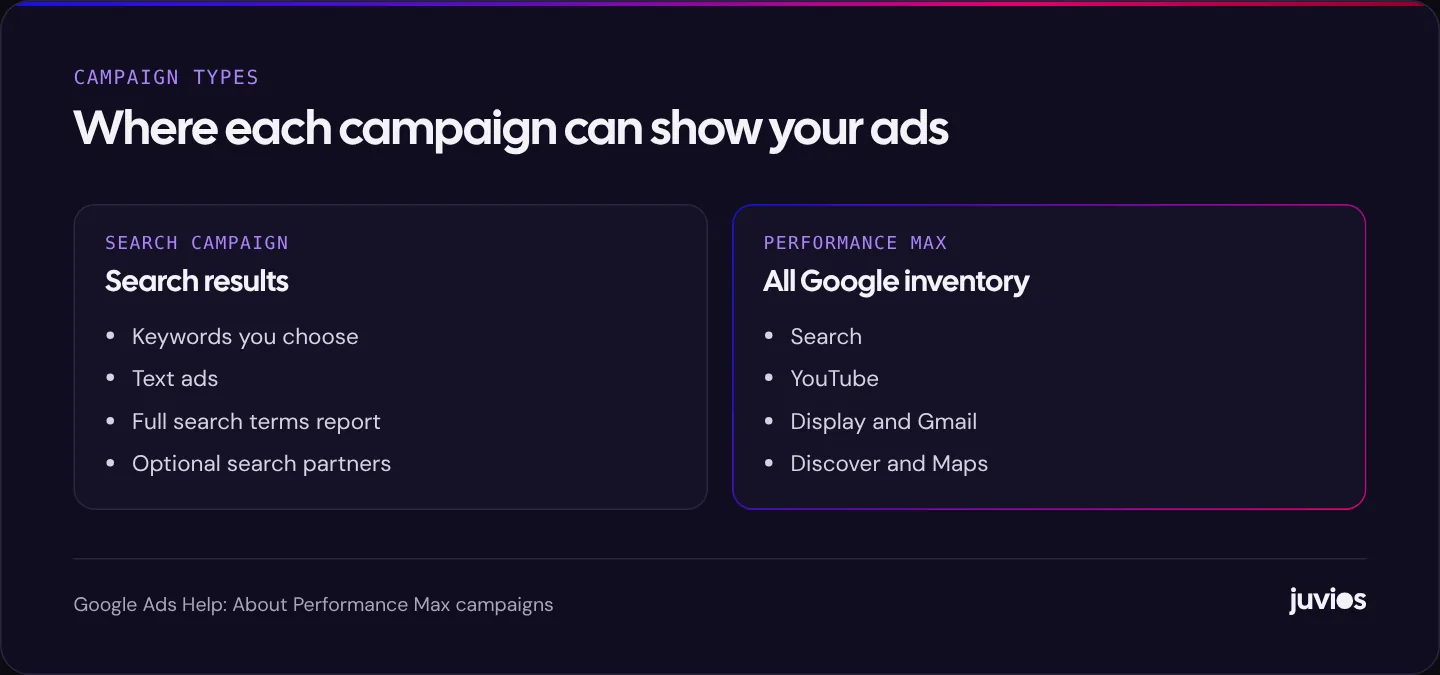
For most small businesses that want enquiries, a Search campaign is the better place to start, and Performance Max is worth testing once conversion tracking is reliable and the account has steady enquiry data. Search shows text ads to people typing searches you choose, and tells you exactly which searches you paid for. Performance Max uses one budget across all of Google’s ad inventory, including Search, YouTube, Display, Discover, Gmail and Maps, and relies on your conversion data and creative assets to decide where to show. This guide explains how each works, where each one tends to go wrong for lead generation, and a simple way to decide.
How Search and Performance Max differ
A Search campaign is built around keywords. You choose the searches you want to appear for, using broad, phrase or exact match, write ads for them, and send each group of searches to a relevant page. You see the search terms that triggered your ads and can block the ones you don’t want.
Performance Max is goal-based. Google describes it as a campaign type that gives access to all Google Ads inventory from a single campaign. Instead of keywords, you provide assets (headlines, descriptions, images, logos and ideally video), a final URL, audience signals and optional search themes. Google’s systems decide which placements, formats and people to show ads to, aiming at the conversions you track.
| Search | Performance Max | |
|---|---|---|
| Where ads show | Google Search results (and optionally search partners) | Search, YouTube, Display, Discover, Gmail and Maps |
| What you target | Keywords you choose, with match types | Goals, assets, audience signals and up to 50 search themes per asset group |
| Creative needed | Text ads | Text, images, logos and ideally video |
| Control over searches | High: keywords, match types, negatives | Lower: negative keywords and brand exclusions at campaign level |
| Search term visibility | Full search terms report | Search terms report available, with less control per query |
| Depends most on | Keyword choice and landing pages | Accurate conversion data and good assets |
 Tap to enlarge
What Performance Max needs from you
Because Performance Max can show in so many places, it needs more raw material than a Search campaign. The quality of that material shapes where and how you appear.
| Input | What it does | What good looks like |
|---|---|---|
| Headlines and descriptions | Text used across Search, Display, Gmail and more | Specific: name the service, the area and a reason to choose you |
| Images and logo | Used on Display, Discover, Gmail and YouTube | Real photos of your work, team or products, not generic stock |
| Video | Used on YouTube and other video placements | Short, simple clips of real jobs or products; captions on |
| Audience signals | Hints about who to look for first | Your customer list and website visitors, where consent allows |
| Search themes | Hints about searches that matter to you | Your best-performing keywords from Search |
| Conversion goals | Defines what success is | Real enquiries, calls or sales only |
Audience signals and search themes are hints, not limits. The campaign can and will go beyond them. The only hard limits are things like locations, languages, negative keywords, brand exclusions and URL rules.
Why Search is usually the right first campaign for lead generation
Small service businesses often have a narrow set of searches that bring customers: the service, the area, and a handful of problems people search for. Search lets you pay only for those, see exactly what you got, and learn quickly which phrases bring enquiries.
- You can start with a small budget and still focus it on high-intent searches.
- The search terms report shows what you paid for, so you can add negatives within days.
- Text ads are quick to write and test; you don’t need images or video to start.
- Problems are easier to diagnose because there are fewer moving parts.
A hypothetical example: a bookkeeping firm serving one city might run a single Search campaign with three ad groups, one each for bookkeeping, payroll and tax returns. Each ad group has a handful of phrase and exact match keywords, ads that repeat the service and city, and a link to the matching service page. Within a month, the search terms report shows which wording people use and which searches waste money. That learning also improves the website copy and any later campaigns, including Performance Max.
The trade-off is reach. Search only finds people who are already searching. If demand is low, or customers don’t know your type of service exists, Search alone can plateau.
Where Performance Max goes wrong for lead generation
Performance Max optimises towards whatever you count as a conversion. That is its strength and its main risk. If the account counts every form submission equally, including spam and poor-fit enquiries, the campaign can learn to find more of those, often cheaply, on placements where people fill forms without much intent.
Common problems
- Weak or soft conversion actions, such as page views or button clicks, set as primary goals.
- Spam form submissions counted as leads, which teaches the campaign to find more spam.
- Branded searches absorbed by Performance Max, making results look better than they are. Brand exclusions help here.
- Generic image or video assets that don’t say clearly what you offer.
- Too little budget for the campaign to gather enough conversion data.
The fix for most of these is upstream: track only real enquiries as primary conversions, filter spam before it reaches Google Ads, and, where possible, import which leads became customers. Our Google Ads conversion tracking guide covers how.
When Performance Max makes sense
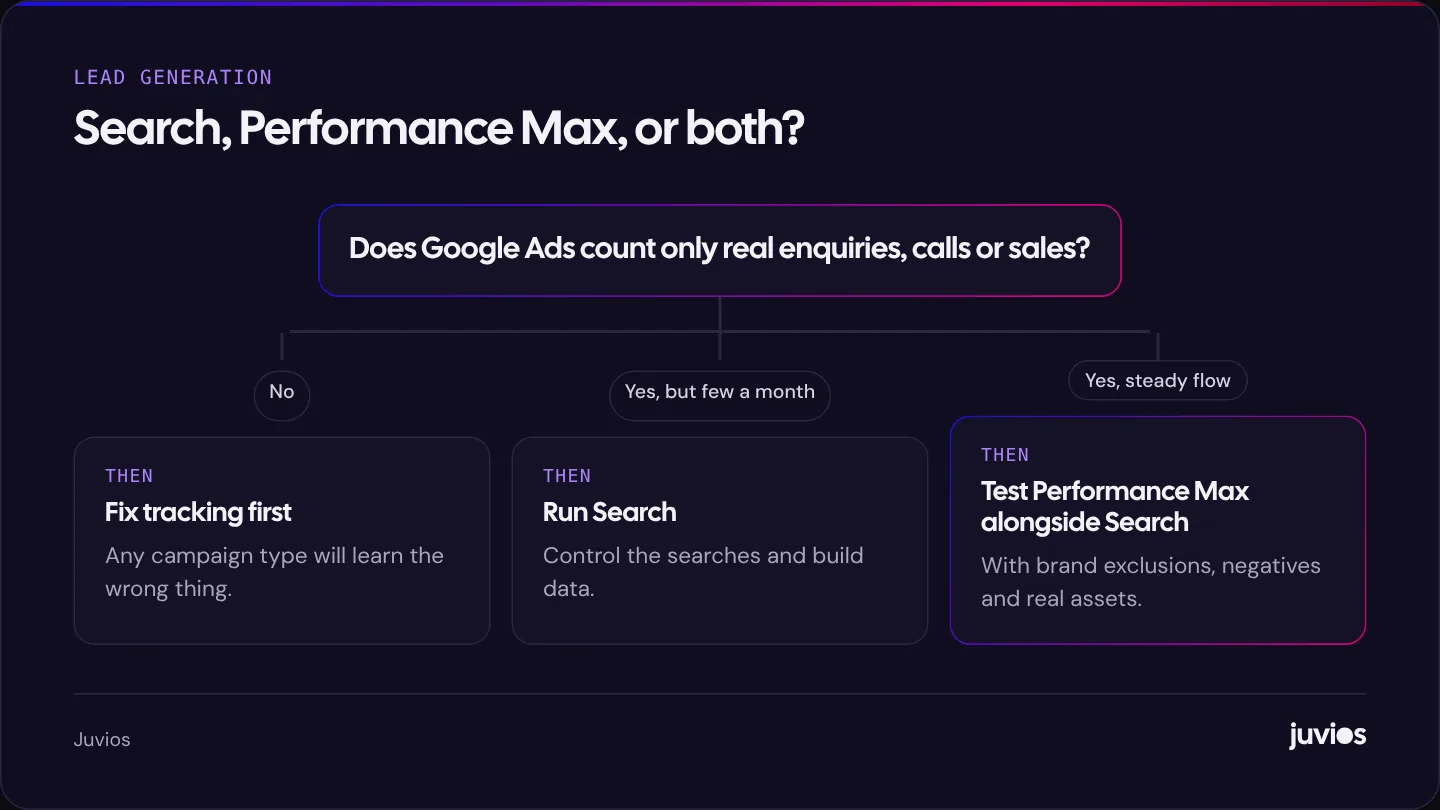
Performance Max is worth testing when most of these are true.
- Conversion tracking counts real enquiries, calls or sales, and nothing softer, as primary goals.
- The account already produces a steady flow of conversions from Search.
- You have good assets: clear images of your work or products, a logo and short videos, or the budget to create them.
- The budget can fund a test alongside Search without starving the campaigns that already work.
- You can judge lead quality, ideally by importing qualified leads or sales back into Google Ads.
For online stores with a product feed, Performance Max is often a natural fit, because product data and purchase values give the campaign clear signals. For lead generation, the quality of the conversion signal decides whether it helps.
Lead generation is different because a form submission tells Google nothing about whether the person became a customer. The closer you can get the conversion signal to real revenue, for example by importing which leads were qualified or won, the more useful Performance Max becomes. Without that, it optimises for form fills, and form fills vary hugely in quality.
 Tap to enlarge
Running Search and Performance Max together
Many accounts run both. Google says search themes in Performance Max have the same priority as phrase and broad match keywords, so a Search campaign with an exact match keyword identical to the query is generally preferred. In practice, keep your most important, proven searches as exact or phrase match keywords in Search, and let Performance Max look for extra demand.
- Add brand exclusions to Performance Max if you run a separate brand Search campaign, so brand searches aren’t credited to it.
- Use campaign-level negative keywords for searches you never want, such as jobs or free.
- Check the Performance Max search terms report regularly, alongside placements and asset performance.
- Compare cost per qualified lead, not just cost per conversion, before moving budget.
A simple structure that suits many small accounts: one Search campaign for your brand name, one or more Search campaigns for core services with exact and phrase match keywords, and, once data allows, one Performance Max campaign with brand exclusions and the same conversion goals. Keep budgets separate so one campaign can’t quietly absorb the others.
A hypothetical test plan
A plumbing business spends about US$1,500 a month on Search and gets steady, tracked enquiries. It keeps Search running at the same budget and adds a Performance Max test at about US$500 a month for six to eight weeks, with brand exclusions, a short list of negatives, search themes based on its best keywords, and photos and short videos of real jobs. At the end, it compares cost per booked job, not just form fills, across both campaigns before deciding whether to keep, change or stop the test.
How to judge the results fairly
Performance Max reports conversions across all its channels together, which makes it easy to compare totals and hard to compare quality. Before you decide, look past the headline cost per conversion.
| Search | Performance Max | |
|---|---|---|
| Spend | US$3,000 | US$1,000 |
| Tracked conversions | 60 | 40 |
| Cost per conversion | US$50 | US$25 |
| Leads that were a good fit | 42 | 12 |
| Cost per good-fit lead | US$71 | US$83 |
In this example, Performance Max looks twice as efficient on the account dashboard, but costs more per useful lead once quality is counted. The opposite can also happen. The point is to judge both campaigns on the measure that matters to the business.
- Check the Performance Max search terms report for brand searches and irrelevant terms.
- Look at which assets and placements get the most spend, and replace weak assets.
- Compare lead quality by source in your CRM or a simple spreadsheet.
- Allow enough time: a few weeks at minimum, longer if conversions are few.
If tracking leads by source is new to you, how to track which marketing brings in enquiries explains a simple set-up that works for any channel.
Common misunderstandings
“Performance Max is just Smart campaigns renamed”
No. Smart campaigns are a simplified campaign type aimed at very small advertisers. Performance Max is a full campaign type with its own assets, signals, bidding and reporting, and needs more set-up and more data to work well.
“Audience signals limit who sees the ads”
They don’t. Signals help the campaign start in the right place, but it can show ads to people outside them. Use location, language and exclusion settings if you need hard limits.
“More conversions means it’s working”
Only if the conversions are real. If form spam, newsletter sign-ups or page views are counted as primary goals, Performance Max can report more conversions while the business gets fewer customers.
“You can’t see search terms”
You can. Google provides a search terms report for Performance Max. It gives less control than a Search campaign, because you can’t bid on individual terms, but you can review them and use negatives and brand exclusions.
In short
Search gives you control and clarity, which is what a small lead generation account needs first. Performance Max gives you reach, which is useful once Google knows what a good lead looks like. Build tracking you trust, prove Search works, then test Performance Max with clear limits, a fixed review date and a measure of success based on real customers, not dashboard conversions.
Checklist before launching Performance Max
- Primary conversions are real enquiries, calls or sales.
- Spam protection is on your forms.
- Brand exclusions and campaign-level negatives are set.
- Assets include clear headlines, real images and at least one video.
- The final URL setting and any URL exclusions are reviewed, so traffic lands on relevant pages.
- You have a date to review results and a measure of success agreed in advance.
Write these down before launch. It is much easier to judge a test fairly when the rules were set before the results came in.
If your current campaigns get clicks but no enquiries, sort that out before adding a new campaign type. Start with our diagnosis guide.
Common questions
Can Performance Max replace my Search campaigns?
It can show on Search, but replacing Search entirely means giving up keyword-level control and a full view of which searches you pay for. Most small lead generation accounts are better served by keeping Search for core terms.
Do I need video for Performance Max?
Video is strongly recommended because the campaign can show on YouTube. If you don’t supply it, you lose control of how you appear there, so short, simple videos of your real work are worth making.
Is Performance Max good for a small budget?
Usually not as a first campaign. With a small budget, the data is thin and the spend is spread across many channels. Search tends to be easier to control and judge.
Sources
- About Performance Max campaigns Google Ads Help
- Use search themes with your Performance Max campaign Google Ads Help
- Search terms insights for Performance Max Google Ads Help
- About Smart Bidding Google Ads Help
- About keyword matching options Google Ads Help