On this page · 15 sections
A small team should usually focus on fewer channels than it thinks. Start with the foundations every business needs (a clear website, a complete Google Business Profile if you serve local customers, reviews, and a way to stay in touch with past customers), then add one channel that captures existing demand, such as search, and at most one that creates new demand, such as social ads. Choose them by how your customers buy, what your team can keep up every week, and the budget you have. Add another channel only when the first ones are working and measured. This guide gives five questions to make that choice, a comparison of the main channels, and starting mixes for common types of business.
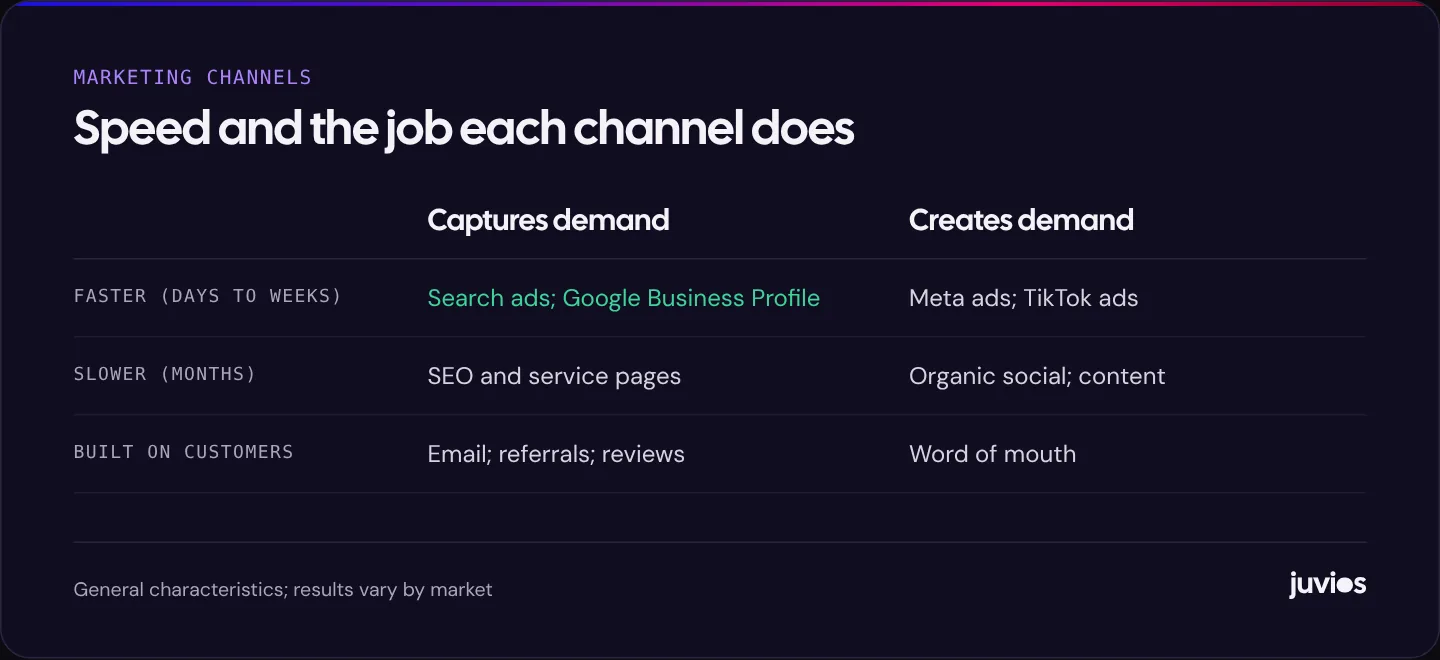
Two jobs channels do: capturing demand and creating it
Some channels reach people who are already looking for what you sell. Someone types “accountant near me” into Google; your search ad, website or Maps listing appears. That’s capturing demand. It tends to produce enquiries quickly, because the person already has the need.
Other channels reach people before they’re looking. A café’s Instagram reel reaches someone who wasn’t planning to go out; a TikTok video shows a product someone didn’t know existed. That’s creating demand. It can grow a business beyond the people already searching, but it usually takes longer and needs more creative work.
Most small businesses should capture existing demand first, because it pays back faster. Creating demand becomes important when search volume is small, when the product is new or visual, or when you’ve already captured most of the searches available.
| Channel | Mainly | Speed to results | Main cost | Ongoing effort |
|---|---|---|---|---|
| Google Search ads | Captures demand | Days to weeks | Ad spend plus management | Weekly reviews |
| SEO and content | Captures demand | Months | Time or fees | Steady writing and upkeep |
| Google Business Profile | Captures local demand | Weeks | Time | Reviews, posts, photos, updates |
| Meta ads (Facebook, Instagram) | Creates and captures | Weeks | Ad spend, creative, management | Fresh creative monthly |
| TikTok ads | Creates demand | Weeks | Ad spend, video creative | Frequent new video |
| Organic social posts | Creates demand, builds trust | Months | Time and content | Regular posting |
| Email to customers and subscribers | Repeat and referral business | Immediate for existing lists | Tool and time | Regular sends |
| Referrals and reviews | Trust and word of mouth | Ongoing | Time | Asking consistently |
Question 1: Do people search for what you sell?
Check whether there’s real search demand in the areas you serve. Google’s Keyword Planner, inside a free Google Ads account, shows search volume ranges and typical costs for keywords. Search for your main services the way a customer would, and look at what appears.
- Clear demand, such as plumbers, dentists, accountants, wedding photographers: search channels should be at the centre of your plan.
- Some demand, mixed with research searches: search still matters, but content and good service pages need to do more work.
- Little or no demand, typical for new products or unusual services: search will struggle to grow you on its own. Discovery channels such as social ads, partnerships and content become more important.
Question 2: How do your customers decide?
Think about the path a typical customer takes from first noticing they have a need to buying from you.
| How customers decide | Examples | Channels that usually fit |
|---|---|---|
| Urgent need, quick decision | Emergency repairs, locksmiths, same-day services | Search ads, Google Business Profile, phone-first website |
| Considered, compare several providers | Kitchen fitting, accountants, web design | Search, SEO service pages, reviews, retargeting, email follow-up |
| Visual or impulse | Food, fashion, gifts, beauty | Social ads and posts, Instagram, TikTok |
| Repeat or habit | Cafés, salons, cleaning, supplies | Email, loyalty, reviews, Google Business Profile, social |
| Long B2B cycle | Software, consulting, wholesale | Search, content, LinkedIn or Meta, email nurturing |
Question 3: Local, national or global?
Location changes the channels that matter. A business serving one town gets much of its visibility from Google Maps results and local searches, so a complete Google Business Profile and real reviews are among the most valuable things it can work on. Google says local results are based mainly on relevance, distance and prominence, and reviews and accurate information feed into all three.
A business selling nationally or globally can’t rely on proximity. It needs search visibility for its services or products, and often paid social to reach people across a wide area. Ads also need more careful location settings and, for global businesses, attention to language and time zones.
Question 4: What can your team keep up every week?
This is the question most channel plans skip, and the one that decides whether they survive. Every channel needs regular work. A channel you start and then neglect often does worse than not starting, because an abandoned social profile or a stale blog signals a business that has gone quiet.
- Search ads need weekly attention: search terms, budgets and bids.
- Social ads need fresh creative at least monthly, and someone to reply to comments and messages.
- Organic social needs regular posts and someone comfortable creating them.
- SEO and content need someone who can write useful guides, or a budget to pay for them.
- Email needs a list, a reason to write, and someone to write it.
Count the hours honestly, including your own. If the team has three hours a week for marketing, that’s probably enough for the foundations plus one channel done well.
Question 5: What can you spend?
Paid channels need enough budget to produce results you can learn from. A small budget split across Google Ads, Meta and TikTok often leaves each one with too few clicks or leads to judge. Concentrate it.
TikTok, for example, sets minimum daily budgets: its Help Centre says a campaign daily budget must exceed US$50 and an ad group’s must exceed US$20. That alone rules it out for some small budgets. Work out what you need from the results you want, using the method in how to set a small business marketing budget.
Other channels worth a thought
The table above covers the channels most small businesses start with, but not all of them. A few others can work well in the right situation.
- Directories and marketplaces: industry directories, booking platforms and online marketplaces can bring enquiries quickly, because customers already use them to compare. Check the fees and who owns the customer relationship.
- Partnerships: businesses that serve the same customers without competing, such as an architect and a builder, can refer work to each other. Low cost, but slow to build.
- Local print and events: still effective for some local businesses, especially with older customers. Use a dedicated phone number, web address or QR code so you can measure them.
- Creators and influencers: can work for visual consumer products. Agree clear terms, label paid posts as required, and track results with tagged links or codes.
- LinkedIn: valuable for many B2B services, both for organic posts by the owner and for ads, which can target by job title and industry. Check LinkedIn’s own cost estimates for your audience before budgeting, because they vary a lot.
Judge each one the same way: does it reach people who buy what you sell, can you sustain it, and can you measure what it brings?
The foundations every business needs first
Before choosing growth channels, make sure the basics are in place. They make every other channel work better and cost little beyond time.
- A clear, fast website that explains what you do, for whom, roughly what it costs and how to get in touch, with one page per main service.
- A complete Google Business Profile if you serve customers locally, with accurate hours, services, photos and a steady flow of genuine reviews.
- A simple way to ask happy customers for reviews and referrals.
- A list of past customers and enquiries you have permission to contact, and a reason to write to them occasionally.
- Tracking that shows where enquiries come from.
If the website is the weak point, start there. Why your website isn’t generating leads shows how to find what’s holding it back.
Starting mixes for common types of business
| Business type | Capture demand with | Create demand with | Add later |
|---|---|---|---|
| Local trades and home services | Google Search ads, Google Business Profile | Meta ads with local targeting | SEO service pages, email to past customers |
| Clinics and personal services | Google Business Profile, Search ads | Instagram content and Meta ads | Email reminders and offers |
| Restaurants and cafés | Google Business Profile | Instagram and TikTok content, Meta ads | Email or loyalty |
| Online shops | Google Shopping or Search | Meta and TikTok ads | Email automation, SEO for category pages |
| Professional and B2B services | Search ads, service pages | LinkedIn or Meta, useful content | Email nurturing, webinars or guides |
 Tap to enlarge
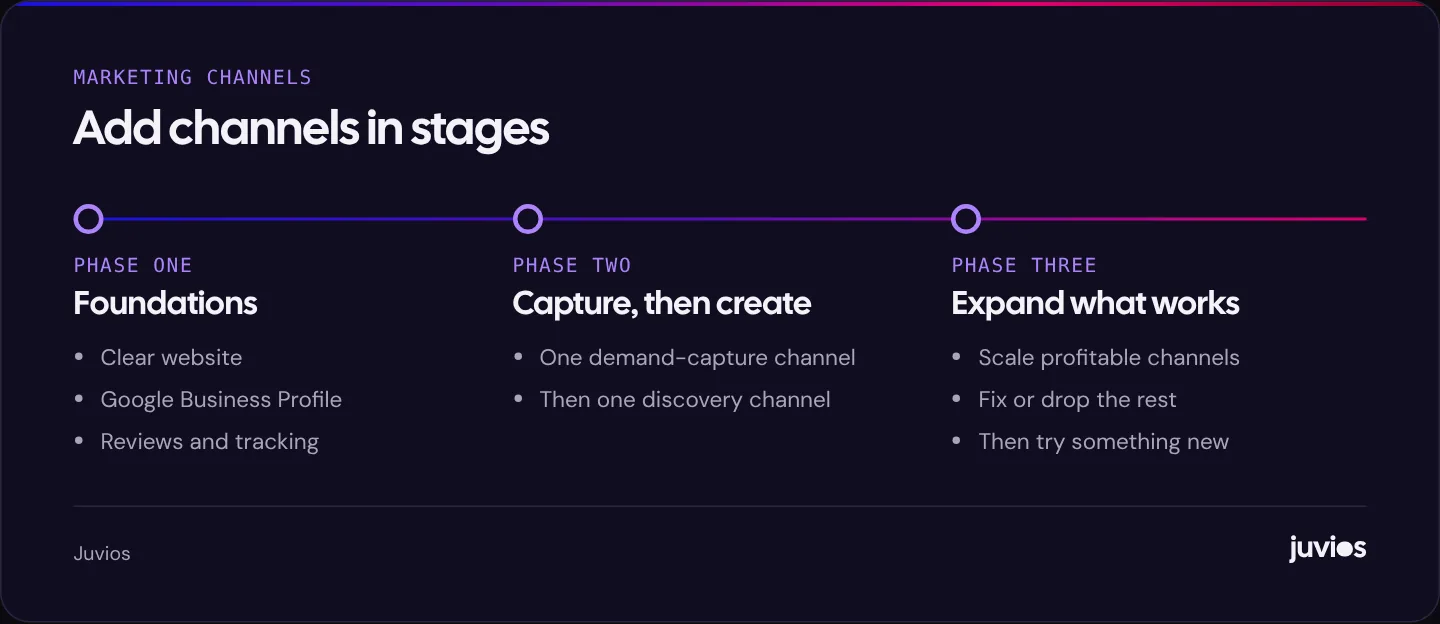
Add channels in stages
Phase one: foundations (first month or two)
Website, Google Business Profile, reviews and tracking. Fix the basics before spending on traffic.
Phase two: one capture channel, then one creation channel
Start the channel that matches how your customers search, usually Google Search ads or local search. Once it’s producing measured enquiries, add one discovery channel, such as Meta ads, with a budget big enough to test properly.
Phase three: expand what works
After three to six months of data, look at cost per customer by channel. Put more into the channels that pay back, improve or drop the ones that don’t, and only then add something new.
When to add or drop a channel
- Add a channel when your current ones are measured, profitable and running smoothly, and you have the time or budget to do the new one properly.
- Scale a channel when cost per customer is comfortably below what a customer is worth and it isn’t yet limited by budget.
- Fix before dropping: check tracking, the offer and the creative before deciding a channel doesn’t work.
- Drop a channel when several honest rounds of improvement haven’t brought cost per customer within reach, or when the team can’t sustain it.
 Tap to enlarge
A worked example (hypothetical)
A two-person landscaping business serving one city has a dated website, an incomplete Google Business Profile with eight reviews, and about US$1,000 a month for marketing. The owner posts on Instagram occasionally.
- Month one: rewrites the website with separate pages for garden design, patios and maintenance; completes the Google Business Profile; starts asking every finished customer for a review; sets up enquiry tracking.
- Months two to three: launches Google Search ads for patios and garden design in the city at about US$700 a month, keeping US$300 in reserve.
- Month four: Search ads are bringing measured enquiries at an acceptable cost per job. The owner adds a small Meta campaign showing before-and-after projects to homeowners nearby, using the reserve.
- Month seven: reviews have grown to over thirty, Maps enquiries have increased, and Meta brings fewer but larger garden design jobs. The owner keeps both paid channels and plans a monthly email to past customers for maintenance work.
Notice what wasn’t done: no TikTok, no blog, no LinkedIn. Not because they can’t work, but because the team couldn’t do everything at once, and the chosen channels matched how its customers buy.
Common mistakes
- Starting on every platform at once because competitors are there.
- Choosing channels by what the owner personally uses rather than what customers use.
- Spending on traffic before the website can turn visitors into enquiries.
- Judging slow channels such as SEO on the same timeline as search ads.
- Splitting a small budget so thinly that no channel produces useful data.
- Not tracking enquiries by source, so channel decisions are guesses.
Once you’ve chosen, write the plan down. Our guide to building a simple digital marketing strategy turns these choices into a one-page plan.
Common questions
How many marketing channels should a small business use?
After the foundations, usually one or two to start: one that captures existing demand and, if budget and time allow, one that creates new demand. Add more once those are measured and working.
Is social media or Google better for a small business?
It depends on how customers buy. If people search for what you sell, Google usually pays back faster. If your product is visual or new, social media often matters more. Many businesses end up using both.
Should I be on every social media platform?
No. Choose the one or two where your customers spend time and where you can post well and regularly. A strong presence on one platform beats a weak presence on four.
Sources
- Tips to improve your local ranking on Google Google Business Profile Help
- Use Keyword Planner Google Ads Help
- About daily budgets TikTok Ads Manager Help Centre
- Search Engine Optimization (SEO) Starter Guide Google Search Central