On this page · 15 sections
If you can only start with one, Meta (Facebook and Instagram) is the safer first choice for most small businesses, because it accepts more kinds of creative, offers more ways to collect enquiries, and has tracking that is well documented. TikTok is worth adding, or even starting with, when your customers are active there and you can produce short, natural vertical videos regularly. The right answer depends less on which platform is “better” and more on three things: where your customers spend time, what creative you can make, and how much budget you have. This guide compares the two on each point and shows how to run a fair test.
The short answer
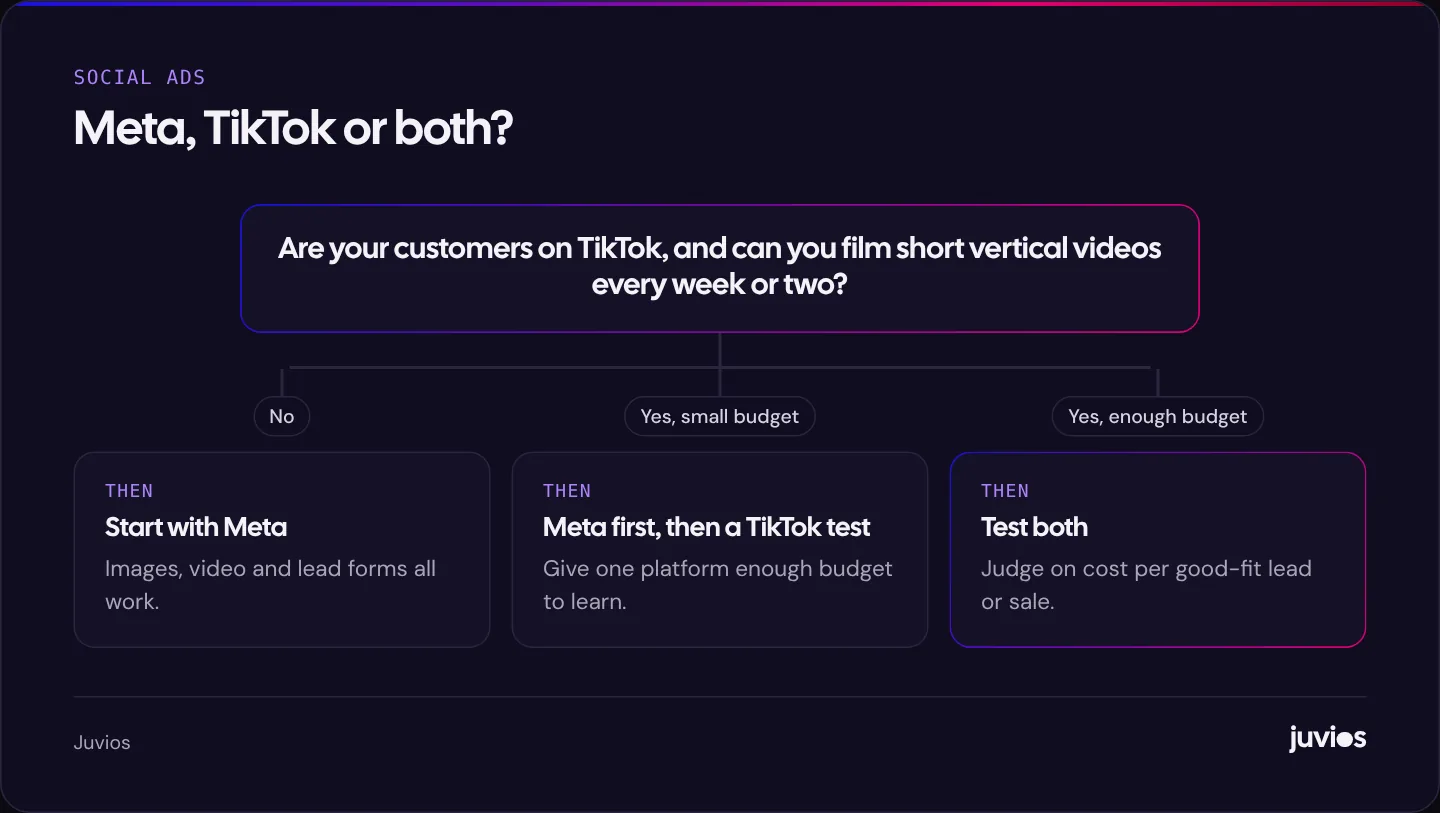
- Choose Meta first if you sell to a wide age range, rely on enquiries or bookings, have photos but little video, or want to retarget website visitors with a mix of formats.
- Choose TikTok first if your customers are on TikTok, your product shows well on camera, and you or your team can film short, unpolished videos every week.
- Run both if you have the creative capacity and enough budget to give each platform a fair test, rather than splitting a small budget too thinly.
 Tap to enlarge
How the two platforms differ
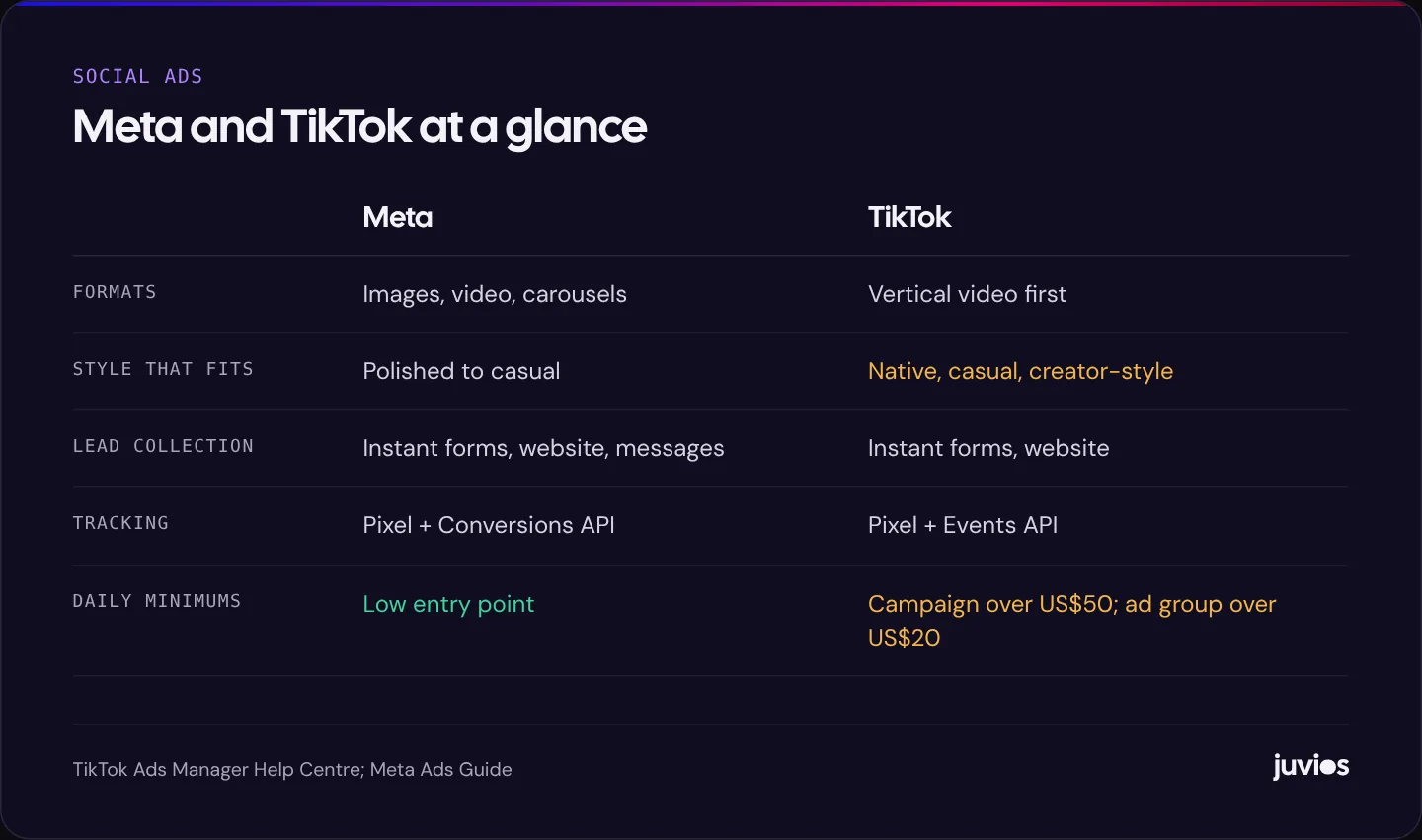
| Meta (Facebook and Instagram) | TikTok | |
|---|---|---|
| Where ads appear | Feeds, Stories, Reels and other placements across Meta’s apps | The TikTok feed and other TikTok placements |
| Creative formats | Images, video, carousels and collections | Vertical video first |
| Creative style that fits | Ranges from polished to casual | Native, casual, creator-style video |
| Lead collection | Instant forms, website forms, messages | Instant forms and website forms |
| Tracking | Meta Pixel and Conversions API | TikTok Pixel and Events API |
| Minimum daily budget | Low entry point; check Ads Manager for your currency | Campaign over US$50; ad group over US$20 (per TikTok Help Centre) |
| Boosting organic posts | Boost posts from Facebook or Instagram | Spark Ads use organic TikTok posts as ads |
 Tap to enlarge
Where are your customers?
Both platforms are used by very large audiences, but not equally in every country, age group or interest. Rather than relying on general statistics, check the audience estimate in each ad platform for your actual targeting: your locations, age range and any essential exclusions. Both Ads Manager tools show an estimated reach before you spend anything.
Then ask your customers. A simple question on your enquiry form or at the till (“Where did you hear about us?”) tells you more about your market than any national survey. If almost nobody mentions TikTok and your competitors aren’t active there, that’s a reason to start with Meta. If customers mention creators or videos they saw on TikTok, it’s a reason to test it.
What creative can you make every month?
This is often the deciding factor. Ads stop working as people see them repeatedly, so both platforms need a steady supply of new creative. The question is what kind.
Meta
Meta works with a wide range of creative. A well-photographed product, a before-and-after image, a carousel of projects or a short video can all perform. Many small businesses can start with images and add video over time.
TikTok
TikTok is built around vertical video with sound. Ads that look like TV adverts or reformatted landscape videos usually stand out for the wrong reasons. What tends to fit is casual, direct-to-camera or behind-the-scenes footage: someone showing the product, answering a common question or walking through a job. TikTok’s own specifications recommend vertical 9:16 video, at least 540 × 960 pixels.
That style is cheaper to produce than it sounds. A phone, good light and someone comfortable on camera go a long way. But it needs regular effort. If nobody in the business wants to be filmed, or you can’t film something new every week or two, TikTok will be hard to sustain.
For sizes and safe areas on each platform, see our guide to social media image and video sizes.
How budget affects the choice
TikTok sets minimum budgets. According to its Help Centre, a campaign-level daily budget must exceed US$50, and an ad group’s daily budget must exceed US$20. A single ad group running every day therefore needs a little over US$600 a month. A small business with US$500 a month for social ads can’t run TikTok every day at those minimums.
Meta’s entry point is lower, which makes it easier to start small. A low budget is still a constraint, though: it limits how many results you get each week and how quickly you can learn what works.
| Monthly social ad budget | Suggested approach | Why |
|---|---|---|
| Under US$600 | Meta only | Too little to run TikTok daily at its minimums and test properly |
| US$600 to US$1,500 | Meta first; test TikTok for a month with one ad group | Enough for a focused TikTok test without starving Meta |
| Over US$1,500 | Both, judged on cost per good-fit lead or sale | Enough data on each platform to compare fairly |
To size the total budget from the results you need, use the method in how much to spend on Facebook and Instagram ads; it works the same way for TikTok.
Which tends to suit which kind of business
| Business type | Usual starting point | Notes |
|---|---|---|
| Local services (trades, clinics, cleaners) | Meta | Enquiry forms, location targeting and image or video creative all work; test TikTok if you can film jobs |
| Restaurants, cafés, salons | Either | Visual, local, easy to film; TikTok suits if you post short videos already |
| Online shops with visual products | Either, often both | Product demos suit TikTok; catalogue and retargeting suit Meta |
| Professional services (accountants, consultants) | Meta | Older decision makers; trust-building content and lead forms |
| Products for younger audiences | TikTok, then Meta | Check audience estimates for your market first |
Set up tracking on both before you compare
A fair comparison needs the same thing counted the same way on both platforms. Each platform has a browser pixel and a server-side connection: Meta’s Pixel and Conversions API, and TikTok’s Pixel and Events API. Set up the events that matter, such as a completed enquiry or purchase, and test them before launch.
Don’t rely only on each platform’s own reporting. Each one takes credit for conversions it was involved in, so their totals can add up to more than the enquiries you actually received. Compare platform reports with your own records, using a lead source field in your form or CRM, and links tagged with UTM parameters so analytics can tell the traffic apart.
Our guides to the Meta Pixel and Conversions API and to tracking which marketing brings in enquiries cover both sides.
Does your organic presence matter?
You don’t need a large following to advertise on either platform. Ads reach people who don’t follow you. But your profile is what people check after seeing an ad, so an empty or abandoned profile can cost you trust.
On Meta, a Facebook Page and Instagram account with recent posts, real photos and reviews is enough. On TikTok, people often tap through to your profile to see more videos. A handful of genuine posts helps, and TikTok’s Spark Ads let you run your own organic posts, or a creator’s with permission, as ads. That keeps the native look and lets likes and comments build on the original post.
Meta has a similar idea: you can boost or use existing Facebook and Instagram posts as ads. In both cases, posts that already did well organically are good candidates to test as ads, because they’ve shown that people find them interesting.
Reaching people again: retargeting on each platform
Many customers need more than one look before they enquire. Both platforms let you show ads to people who visited your website, engaged with your content or are on a customer list you upload, subject to their policies and your consent set-up.
- Meta can retarget website visitors via the Pixel and Conversions API, and people who engaged with your Facebook Page, Instagram account, videos or lead forms.
- TikTok can retarget website visitors via its Pixel and Events API, and people who watched or engaged with your TikTok videos.
- On a small budget, retargeting audiences can be tiny. Combine them, for example all website visitors in the last 30 to 90 days, rather than slicing them into many small groups.
A common pattern for small businesses is to use TikTok or Meta video to introduce the business to new people, then use Meta to remind those who visited the website with reviews, examples and a clear offer. That only works if tracking is set up on both.
What to expect in the first month
The first few weeks on either platform are about learning, so set expectations accordingly. Delivery systems need time and results to settle, and you need time to see which creative works.
| Week | On Meta | On TikTok |
|---|---|---|
| 1 | Check tracking and delivery; costs may swing | Check tracking; watch early view and click rates |
| 2 | First reading of cost per lead by ad | See which hooks hold attention |
| 3 | Pause clear losers; keep two or three ads | Replace weak videos with new hooks |
| 4 | Compare cost per good-fit lead with your target | Same, and decide whether to continue the test |
How to run a fair test between them
- Pick one offer and one goal, such as enquiries for one service.
- Make creative for each platform in its own native style, using the same message. Don’t just reuse the same file everywhere.
- Set each platform’s budget to produce a meaningful number of results within four to six weeks.
- Track the same conversion event on both, and label lead quality in your own records.
- Compare cost per good-fit lead or cost per sale, not clicks, views or cost per lead alone.
- Decide in advance what result would make you keep, change or stop each platform.
Hypothetical example: a bakery with a US$1,300 monthly budget runs Meta at US$650 and TikTok at US$650 (just above TikTok’s daily ad group minimum) for six weeks, both promoting celebration cake orders. Meta brings 28 enquiries, 18 of them good fits; TikTok brings 15, with 11 good fits. Cost per good-fit enquiry is about US$36 on Meta and US$59 on TikTok. The bakery keeps Meta as its main channel and gives TikTok one more round with new hooks, because its best TikTok video was close to Meta’s numbers and the gap may be creative rather than the platform. If the second round doesn’t close the gap, it moves that budget to Meta.
Expect the first weeks on a new platform to be weaker while you learn what creative works there. One failed test isn’t proof the platform can’t work for you; three or four rounds of creative without improvement is a stronger signal.
Common mistakes
- Posting the same landscape video on both platforms and calling it a TikTok test.
- Splitting a small budget across both, so neither gets enough data.
- Judging TikTok on cheap views or Meta on cheap clicks instead of enquiries or sales.
- Skipping server-side tracking, then trusting incomplete numbers.
- Choosing a platform because it’s fashionable rather than because customers are there.
- Giving up on a platform after one round of creative, before you’ve learned what works there.
How we handle Meta and TikTok together
Our marketing packages include both. Standard includes up to 6 Meta campaigns and up to 2 TikTok campaigns a month, alongside 10 social posts. Full Digital raises that to up to 10 Meta and 6 TikTok campaigns, with 16 posts. Ad spend is separate and paid to the platforms. If you only want the ads run, we quote ads-only management.
Common questions
Is TikTok only for young people?
No, but its audience mix differs by country and age group. Check the audience estimate in TikTok Ads Manager for your own locations and ages rather than relying on general claims.
Can I use the same videos on Instagram Reels and TikTok?
Often, yes, if they’re vertical, made natively and free of another platform’s watermark. Check each platform’s safe areas so text isn’t hidden under buttons and captions.
Do TikTok ads work for B2B?
Sometimes, especially for products that are easy to demonstrate. For most small B2B services, Meta and Google Ads are more predictable starting points.
Sources
- About daily budgets TikTok Ads Manager Help Centre
- TikTok auction in-feed ads specifications TikTok Ads Manager Help Centre
- Meta Ads Guide Meta
- Meta Conversions API Meta for Developers