On this page · 15 sections
The most reliable way to set a small business marketing budget is to work backwards from the customers you need: how many new customers a month, how many enquiries that takes, what each enquiry is likely to cost, and what a customer is worth to you. Add the fixed costs of being findable (website, tools, basic content), keep a small reserve for testing, and review the numbers every month. Percentage-of-revenue rules can be a sense check, but they don’t tell you whether the plan can produce the customers you need. This guide shows the working, with a hypothetical example you can copy.
Three ways businesses set a marketing budget
| Method | How it works | Strength | Weakness |
|---|---|---|---|
| Percentage of revenue | A fixed share of current or expected revenue | Simple; scales with the business | Says nothing about what the money will achieve |
| Match competitors | Spend roughly what others seem to spend | Keeps you visible | You rarely know their real spend or results |
| Work back from goals | Customers needed × cost to win each one, plus fixed costs | Ties spend to results you can check | Needs estimates that you must update with real data |
Percentage figures are widely quoted, but they come from very different businesses. Gartner’s 2025 CMO Spend Survey, for example, found marketing budgets averaging 7.7% of company revenue, but the people surveyed were marketing leaders at large organisations, most with annual revenue above US$1 billion. That’s useful context, not a target for a five-person business.
The goal-based method is the one we recommend for small businesses, because it answers the question owners actually ask: what will I get for this money?
Step 1: Work out what a customer is worth
Before deciding what to spend to win a customer, work out what a customer brings in. For a one-off sale, that’s the gross profit on the sale. For repeat business, it’s the gross profit over the time a typical customer stays.
Hypothetical example: a home cleaning business charges about US$120 per clean. After paying cleaners and supplies, about US$45 is gross profit. A typical customer books every two weeks for about a year, so roughly 26 cleans, or US$1,170 of gross profit over that year.
That number sets a ceiling. If it costs more than US$1,170 to win a customer, the business loses money on each one. In practice, you’ll want to spend well below the ceiling, both to stay profitable and because your estimate will be off in one direction or the other.
Step 2: Work back from the customers you need
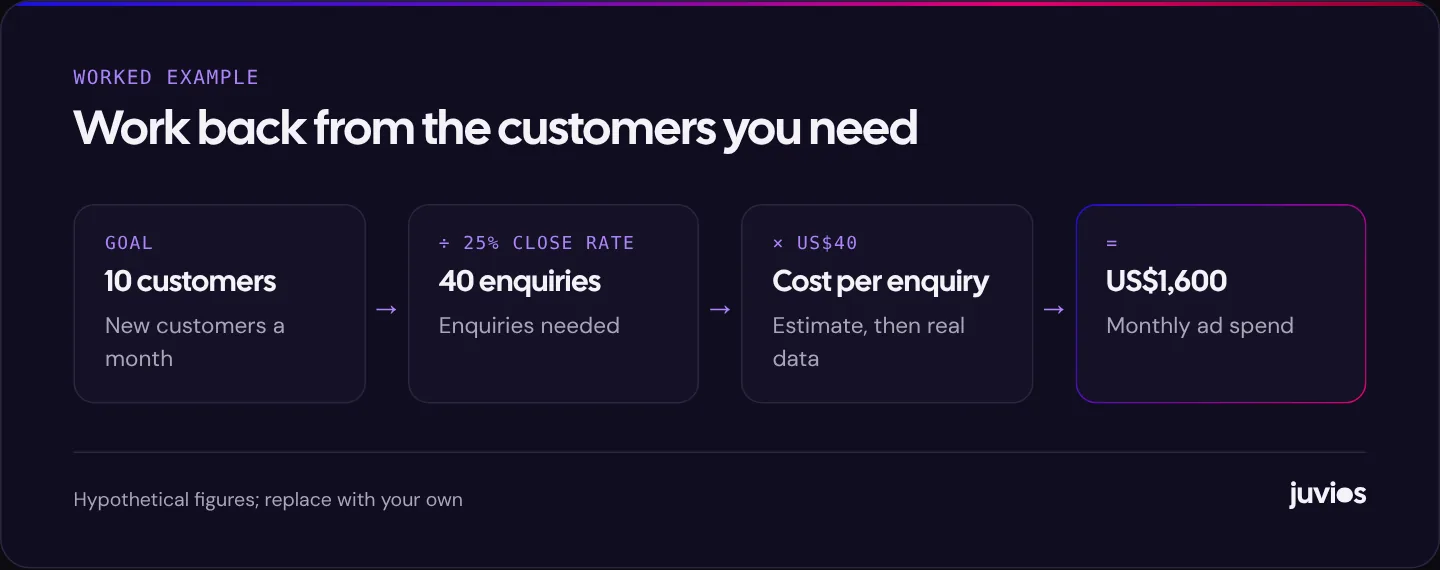
Now turn your growth goal into enquiries and then into spend. You need three estimates: how many new customers you want each month, what share of enquiries become customers (your close rate), and what an enquiry costs from your main channels.
 Tap to enlarge
| Step | Figure | Working |
|---|---|---|
| New customers wanted per month | 10 | Goal |
| Close rate (enquiries that book) | 25% | From past enquiries |
| Enquiries needed per month | 40 | 10 ÷ 0.25 |
| Expected cost per enquiry | US$40 | Estimate from platform tools; replace with real data |
| Monthly ad spend | US$1,600 | 40 × US$40 |
| Cost per new customer | US$160 | US$1,600 ÷ 10 |
| Customer value (first-year gross profit) | US$1,170 | From Step 1 |
If your close rate is unknown, look back at the last 20 or 30 enquiries and count how many became customers. If your cost per enquiry is unknown, start with estimates from the ad platforms’ planning tools and treat the first month or two as a way to learn the real figure.
Step 3: Add the fixed costs of being findable
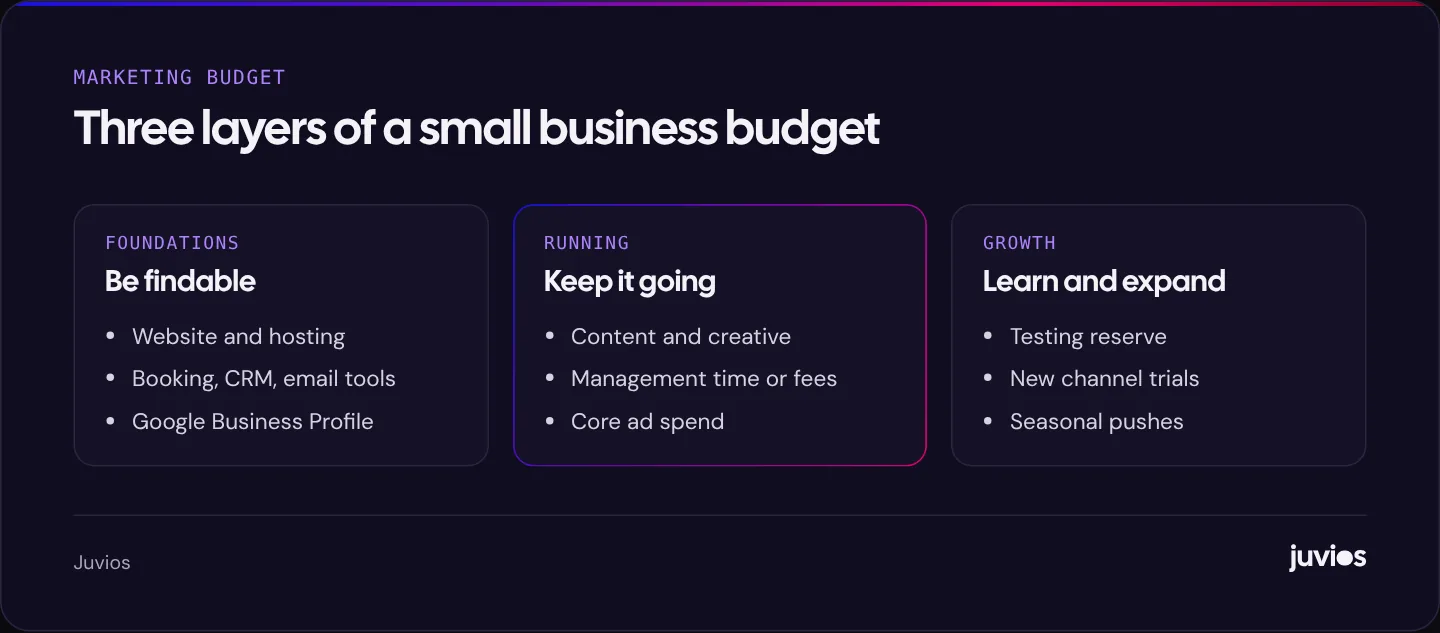
Ad spend isn’t the whole budget. Some costs exist whether or not you advertise, and they make every channel work better.
| Group | Examples | Notes |
|---|---|---|
| Foundations | Website hosting and maintenance, domain, email, booking or CRM tools | Mostly fixed; review yearly |
| Content | Photos, video, social posts, design | Needed for both organic posts and ads |
| Paid media | Google Ads, Meta and TikTok ad spend | Scales with goals; easiest to adjust |
| People and services | Agency or freelancer fees, staff time | Often the largest cost after ad spend |
| Testing reserve | New channels, offers or creative | A small share kept for experiments |
Fixed costs are easy to underestimate because they arrive as small monthly subscriptions. List every tool you pay for, what it does and whether anyone uses it. Cancelling one unused tool can fund a month of testing.
One-off costs, such as a new website, are best treated separately from the monthly budget, then spread across the period you expect them to last when judging overall return.
Step 4: Split the budget sensibly
There’s no universal split, but a few principles hold for most small businesses.
- Fix the foundations first. Ads sent to a slow website that doesn’t explain your offer waste money however good the targeting is.
- Concentrate paid spend. One or two channels with enough budget to learn beat four channels with too little to judge.
- Fund the content your channels need. Social ads without fresh creative fade quickly; Search ads without good landing pages underperform.
- Keep a small reserve, perhaps a tenth of the variable budget, to test something new each quarter. That’s a working habit, not a rule from research.
 Tap to enlarge
Choosing which channels to concentrate on is a decision of its own. Which marketing channels should a small business focus on? covers it in detail.
A complete hypothetical budget
Putting the steps together for the cleaning business, a first monthly budget might look like this. Figures are illustrative.
| Item | Monthly | Why |
|---|---|---|
| Google Ads spend | US$1,000 | Captures people already searching for cleaners |
| Meta ads spend | US$600 | Reaches local households before they search |
| Ads and content management | Agency or freelancer fee | Depends on scope; get quotes |
| Website, hosting and booking tool | US$80 | Foundations |
| Photos and short videos | US$150 | Monthly content for ads and posts |
| Testing reserve | US$160 | About a tenth of ad spend for a new offer or channel |
For reference, our own monthly marketing packages, which combine social content with Meta and TikTok campaign management, are US$280 a month for Standard and US$460 a month for Full Digital, with ad spend paid separately to the platforms. Google Ads management is priced separately.
Check the payback period, not just the cost
Cost per customer tells you whether a channel can work. Payback period tells you whether your cash flow can survive while it does. It’s the time it takes for a customer’s gross profit to repay what it cost to win them.
In the cleaning example, each customer costs about US$160 to win and brings roughly US$90 of gross profit a month (two cleans at US$45). The spend is repaid in under two months. A business with a much longer payback, for example one that wins customers for US$900 who then pay back US$50 a month, needs to fund 18 months of spend before it breaks even on each one. That might still be a good investment, but it needs cash in the bank to support it.
If the payback period is longer than you can fund, either lower the cost per customer, raise the value of the first sale, or grow more slowly.
How the working changes by type of business
| Business type | Key number to get right | Budget tends to lean towards |
|---|---|---|
| Local services with repeat customers | Customer lifetime gross profit | Search ads, Google Business Profile, reviews, referrals |
| One-off, high-value services | Close rate and lead quality | Search ads, strong service pages, follow-up |
| Online shops | Gross margin and repeat purchase rate | Shopping and social ads, email to past customers |
| B2B services | Length of the sales cycle | Search, LinkedIn or Meta, email nurturing, content |
| Hospitality and retail | Visits and average spend | Social content and ads, local search, offers |
When to increase the budget
Increase spend when the numbers say a channel can take more, not because it’s a new quarter. Good signs include a cost per customer comfortably below what a customer is worth, enquiries that your team can handle well, and a channel that isn’t yet limited by budget, for example Google Ads campaigns showing they lose impressions because of budget.
Increase in steps, perhaps 20% to 30% at a time, and watch whether cost per customer holds. It often rises as you reach further beyond your best prospects. If it climbs above your limit, step back to the last level that worked.
How long before you can judge the budget?
Different channels pay back on different timelines, so judge each one on the right clock.
- Search ads can produce enquiries within days, but need a few weeks of data to tune.
- Social ads need time for creative testing; plan on at least one or two months before judging.
- SEO and content usually take months to build visibility, so judge them on leading signals first, such as impressions and rankings for target searches, then on enquiries.
- Email and referrals depend on the customers you already have, and pay back over the long term.
Whatever the channel, you can’t judge it without knowing where enquiries come from. Set that up before spending: how to track which marketing brings in enquiries shows a simple approach.
Review monthly, adjust quarterly
A budget is a plan, not a promise. Review the numbers each month and make bigger changes each quarter.
- Each month, compare enquiries, close rate and cost per customer by channel with your estimates.
- Replace estimates with real figures as soon as you have them.
- Each quarter, move money from channels that cost more per customer than they’re worth to those that cost less.
- Plan for seasonality: if you have busy and quiet months, decide in advance whether to spend ahead of the peak or hold back in quiet periods.
- Keep a note of changes, so you can explain later why results moved.
A one-page monthly summary is enough: spend by channel, enquiries by channel, customers won, and cost per customer. Over a year, it becomes the best evidence you have for next year’s budget.
What if the budget is very small?
If the working shows you need more than you can afford, change the plan rather than spreading too little across everything.
- Start with the free foundations: a complete Google Business Profile, a clear website, reviews from happy customers and a simple way to ask past customers for referrals.
- Choose one paid channel that matches how your customers buy, and give it enough budget to learn.
- Narrow the target: one service, one area, one type of customer, until it works.
- Lower the goal for now, and grow the budget as results come in.
Your own time is part of the budget too. If you post on social media, write blog guides or run your own ads, note roughly how many hours each takes. Owners often discover that a cheap channel is expensive once their time is counted, and that paying for help with one task frees hours for work only they can do.
Common budgeting mistakes
- Picking a number without linking it to customers needed or customer value.
- Using revenue instead of gross profit to judge what a customer is worth.
- Spreading a small budget across too many channels.
- Forgetting content, tools and management time.
- Judging slow channels such as SEO on the same timeline as search ads.
- Not tracking enquiries by source, so nobody knows what’s working.
Common questions
What percentage of revenue should a small business spend on marketing?
There’s no single right percentage. Large-company surveys put averages around 7.7% of revenue, but small businesses vary widely. Work back from the customers you need and what each is worth, then use percentages only as a sense check.
Should a new business spend more on marketing?
Often, yes, because it has no existing customers or reputation to bring in work. But the same rule applies: tie spend to the enquiries you need and track what each channel produces.
Is ad spend part of the marketing budget?
Yes. Ad spend, management fees, content, tools and website costs are all part of it. Keep ad spend visible as its own line so you can compare channels fairly.
Sources
- Gartner 2025 CMO Spend Survey: marketing budgets flatline at 7.7% of company revenue Gartner
- Conversions vs. key events in Google Analytics Google Analytics Help
- Use Keyword Planner Google Ads Help